
SaaS Management Platform: How US Companies Control Software Sprawl and Spend in 2026
Table of Contents
What is a SaaS management platform?
A SaaS management platform (SMP) is software that gives IT, finance and security teams one place to see and control every SaaS application in the company. It answers four basic questions:
1. What apps do we have?
SaaS discovery finds every tool in use, including ones bought on personal cards or free plans.
2. Who is using them?
Usage tracking shows active users, inactive licenses and how often each app is used.
3. What are we paying?
SaaS spend management tracks contracts, renewals, invoices and variable charges.
4. Is it safe?
Security views show which apps hold sensitive data, which have risky permissions and which users still have access after leaving.
With those answers in one dashboard, a SaaS management platform helps teams cut waste, renew smarter and reduce security risk.
How SaaS discovery works
A good SaaS management platform pulls data from several sources to build a complete app inventory:
• Single sign-on (SSO) and identity providers show apps connected to company logins.
• Finance and expense systems reveal software paid for by card or reimbursed through expenses.
• Browser extensions detect web apps that employees log into directly.
• Email and OAuth connections catch apps that employees authorized with their work accounts.
• Direct API integrations pull detailed usage and license data from major apps.
Relying on SSO alone usually misses a large share of shadow IT, so multi-source SaaS discovery is a key buying criterion.
The SaaS sprawl problem
SaaS sprawl happens when a company accumulates more apps than it can track. It usually grows quietly:
• A marketing team signs up for a design tool on a free trial, then upgrades on a corporate card.
• Three departments buy three different project management tools that do the same job.
• An employee leaves, but still has access to a file-sharing app with client documents.
• An annual contract auto-renews at a higher price because nobody saw the reminder.
• A new AI feature adds usage charges that nobody budgeted for.
Each issue looks small. Together, they create wasted spend, security gaps and compliance risk. Cloud platforms already account for about 45% of SaaS budgets, so even modest waste adds up to real money.
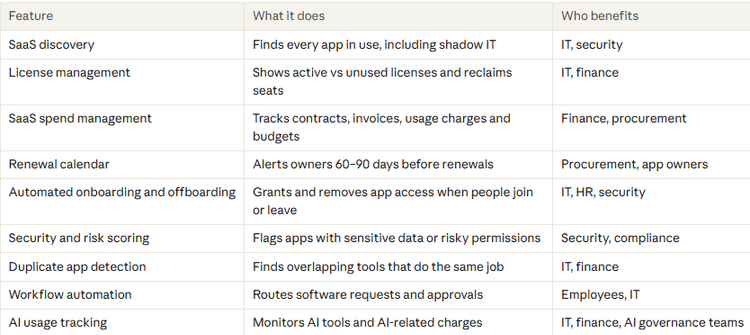
Core features of a SaaS management platform
Benefits of a SaaS management platform
Cut wasted spend. License management finds unused seats and duplicate tools, so you stop paying for software nobody uses.
Better negotiations. With real usage data, procurement can right-size contracts and negotiate from facts at renewal time.
Stronger security. Automated offboarding removes access the day an employee leaves, closing one of the most common security gaps.
Less shadow IT. SaaS discovery brings hidden apps into view, so IT can review security and data handling.
Faster audits. Compliance teams can show auditors a complete list of apps, owners and access rights for SOC 2, HIPAA or other reviews.
Control over AI costs. As AI features and usage-based pricing grow, SaaS spend management helps finance track variable charges month to month.
Happier employees. A self-service app catalog lets staff request approved tools quickly, which reduces the urge to buy on their own.
How to choose a SaaS management platform
Use these criteria when comparing vendors:
1. Discovery depth. Does the SaaS management platform combine SSO, finance, browser and OAuth data? Ask how many apps it typically finds compared with SSO alone.
2. Integrations. Check native connections to your identity provider, HR system, accounting software and your largest SaaS apps.
3. Automation. Can it automatically onboard and offboard users, reclaim unused licenses and route purchase requests?
4. Spend visibility. Does SaaS spend management cover both fixed subscriptions and variable usage-based charges, including AI credits?
5. Security features. Look for risk scoring, OAuth permission reviews and alerts for sensitive data access.
6. Ease of use. Finance and department managers should be able to use it, not only IT.
7. Pricing model. Most platforms charge per employee. Compare the cost against the savings you expect from license management.
8. Proof of savings. Ask for case studies from US companies of your size and industry.
For more info on easy automation solutions visit Klamp Embed & Klamp Connectors