
Agentic AI Software: 2026 Guide for US Businesses
Table of Contents
Where earlier AI tools waited for a prompt and returned an answer, agentic AI software takes a goal, plans the steps and completes the work across your apps. A Salesforce CIO survey reports that enterprise AI adoption has jumped more than 280%, and it names agentic AI as a core priority for 2026.
For US companies, this is a practical shift, not a buzzword. AI agents can now resolve support tickets, update CRM records, reconcile invoices and route IT requests with little human input. The companies that learn how to deploy agentic AI software safely will move faster and spend less on repetitive work.
This guide explains what agentic AI software is, how AI agents work, where they deliver value, what risks to watch and how to pick the right agentic AI platform for your team.
What is agentic AI software?
Agentic AI software is a type of AI application that can act on its own to reach a goal. You give an AI agent an objective, such as “close out all billing tickets older than three days.” The agent then decides which steps to take, which tools to use and when the job is done.
Three traits separate agentic AI from a regular chatbot:
• Autonomy. Autonomous AI agents choose their next action instead of following a fixed script.
• Tool use. AI agents call APIs, read databases, send emails and update records inside the software you already use.
• Memory and feedback. An agentic AI platform remembers context, checks its own results and retries when a step fails.
A chatbot answers “What is the refund policy?” Agentic AI software reads the customer’s order, checks the policy, issues the refund and logs the result. That difference, from answering to acting, is why agentic AI software is reshaping SaaS.
Agentic AI vs traditional automation
Traditional automation follows rules a person writes in advance: if X happens, do Y. It breaks when something unexpected appears. Agentic AI adapts its plan based on new information, so agentic workflows can handle messy, real-world cases like incomplete forms or unusual customer requests.
This does not make rules-based automation obsolete. Many US teams combine both: fixed rules for simple, high-volume steps and agentic AI software for the steps that need judgment.
How agentic AI software works
Most agentic AI software follows the same loop, whether it runs one agent or many.
1. Goal. A person or system gives the AI agent an objective and limits, such as a budget or a list of approved tools.
2. Plan. The agent breaks the goal into steps using a large language model.
3. Act. The agent calls tools: a CRM API, a ticketing system, a spreadsheet or an email inbox.
4. Check. The agentic AI platform reviews the result. If a step fails, the agent adjusts its plan and tries again.
5. Report. The agent logs every action and hands off to a human when it reaches a decision it is not allowed to make.
More advanced agentic AI software uses multi-agent systems. One agent researches, another writes, a third reviews, and a supervisor agent coordinates them. Multi-agent agentic workflows suit complex jobs like preparing a sales proposal or investigating a security alert.
Benefits of agentic AI software for US businesses
Lower cost per task
AI agents handle repetitive work around the clock, so staff spend time on customers and strategy instead of copy-paste tasks.
Faster response times
Autonomous AI agents can triage and resolve routine requests in minutes, which matters for US customers who expect same-day answers.
Work across silos
Agentic AI software moves data between tools that do not talk to each other, cutting the manual handoffs between sales, finance and support.
Scales with demand
During peak seasons, such as Black Friday or tax season, an agentic AI platform adds capacity without new hires.
Better data
Because every agent action is logged, agentic workflows create a clean record of what was done, when and why.
Top use cases for agentic AI software in the USA
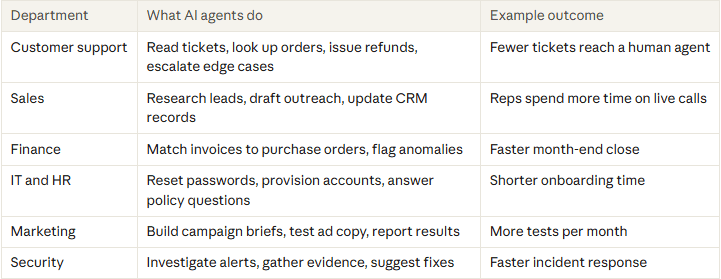
ServiceNow, for example, uses agentic workflows to automate infrastructure changes, approvals and tickets across IT and HR. Many US mid-market companies start smaller, with one agentic AI software pilot in customer support, because the results are easy to measure.
Industry examples
• Healthcare: AI agents handle prior-authorization paperwork and appointment reminders, with strict limits on patient data.
• E-commerce: Agentic AI software tracks returns, updates inventory and answers “Where is my order?” messages.
• Real estate: AI agents qualify buyer leads and schedule showings.
• Professional services: Agentic AI drafts reports from meeting notes and logs billable hours.
Risks of agentic AI software
Agentic AI software is powerful because it acts, and that is also its main risk. US businesses should plan for four issues before rollout.
• Wrong actions. An AI agent can misread a request and refund the wrong order or email the wrong client. Start with low-risk tasks and require human approval for money, contracts or customer data.
• Security and access. AI agents need credentials to act. Give each agent the least access it needs, and rotate keys like you would for any service account.
• Cost surprises. Many agentic AI platforms charge per action or per token. A looping agent can burn through credits, so set spend caps and alerts.
• Compliance. Regulated US industries must show who did what and why. Choose agentic AI software that logs every step and maps to frameworks like ISO 42001 for responsible AI management.
How to choose agentic AI software
Use this checklist when comparing agentic AI platforms:
1. Integrations. Does the agentic AI software connect to your CRM, help desk, ERP and identity provider out of the box?
2. Guardrails. Can you set approval steps, spending limits and blocked actions for each AI agent?
3. Audit trail. Is every agent action recorded with inputs, outputs and timestamps?
4. Human handoff. How does the agent escalate when it is unsure?
5. Pricing model. Is pricing per seat, per agent, per task or usage-based? Model your expected volume before you sign.
6. Data controls. Where is your data stored, and is it used to train the vendor’s models? US buyers should confirm SOC 2 reports and data residency.
7. Proof of value. Ask for a 30–60 day pilot with a clear metric, such as tickets resolved or hours saved.
Frequently asked questions
What is the difference between agentic AI software and a chatbot?
A chatbot answers questions. Agentic AI software plans and completes multi-step tasks across your apps.
Is agentic AI software safe for small businesses?
Yes, if you start with low-risk tasks, limit each AI agent’s access and keep a human in the loop for important decisions.
How much does agentic AI software cost?
Pricing varies widely. Many agentic AI platforms use per-task or usage-based pricing, so total cost depends on volume.
Will AI agents replace employees?
In most US companies, autonomous AI agents take over repetitive tasks, while people handle judgment, relationships and exceptions.
What skills does my team need?
A process owner who understands the workflow, an admin who manages access, and someone who reviews agent logs each week.
For more info on easy automation solutions visit Klamp Embed & Klamp Connectors